How I Finally Understood AI (Without Feeling Overwhelmed)
When I first started learning AI, every term sounded scary.
Transformer. Attention. Embeddings. Positional Encoding. Cross Entropy Loss. Backpropagation.
Honestly, it felt like everyone already knew these concepts except me.
But after spending time understanding them one by one, I realized something surprising.
AI is not as complicated as it looks. The difficult part is the vocabulary. Once you understand the meaning behind the terms, everything starts connecting like pieces of a puzzle.
So, if you're a beginner, this blog is for you.
Everything Starts With Text
Suppose we give AI a simple sentence:
"I love programming."
Humans read words.
Computers don't.
A computer only understands numbers.
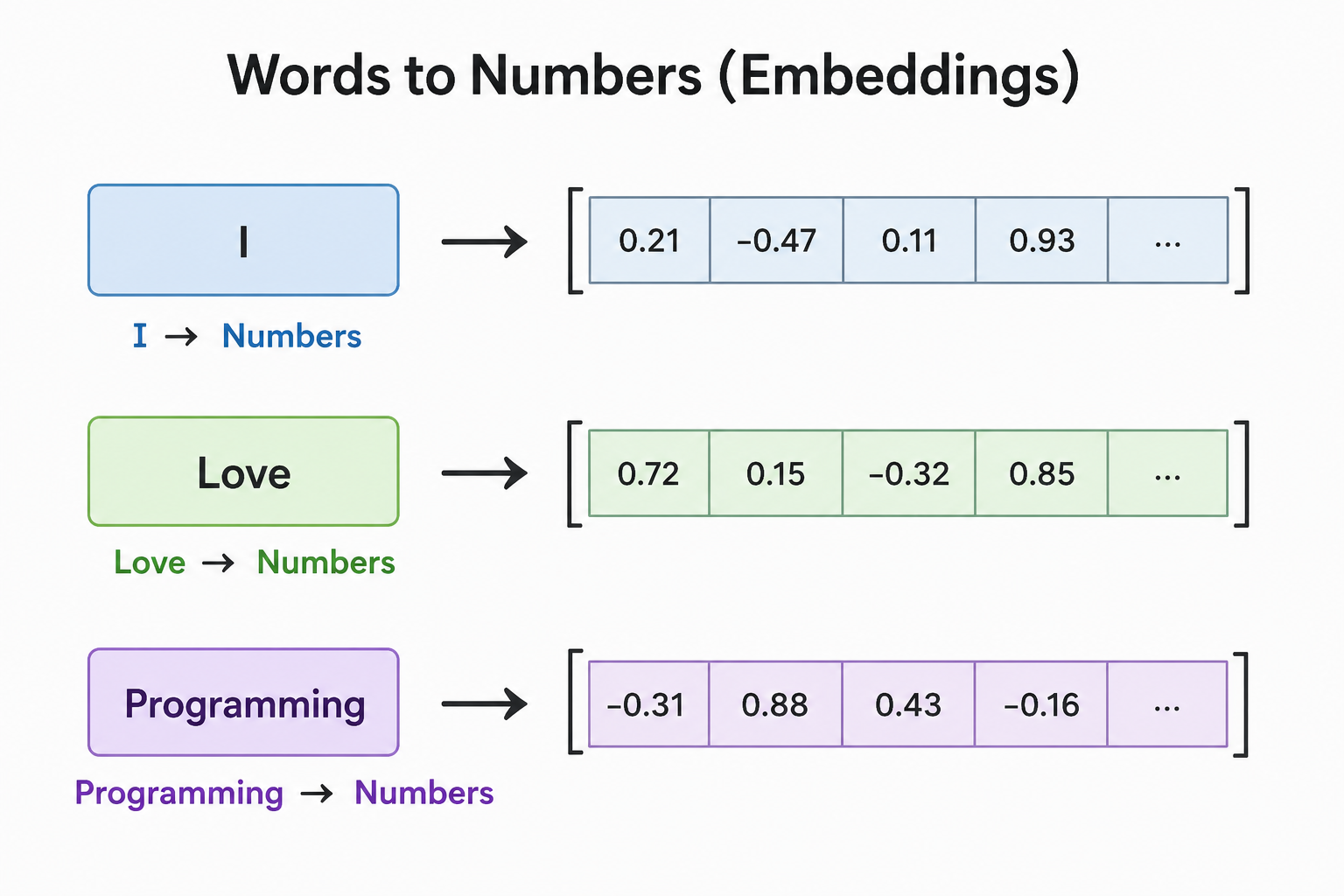
So before AI can understand the sentence, it first converts every word into numbers.
This process is called Embedding.
Think of embeddings as a numerical representation of words.
For example:
I → Numbers
Love → Numbers
Programming → Numbers
The actual numbers are much larger, but the idea is simple.
Every word gets converted into a vector of numbers.
Similar Words Stay Close Together
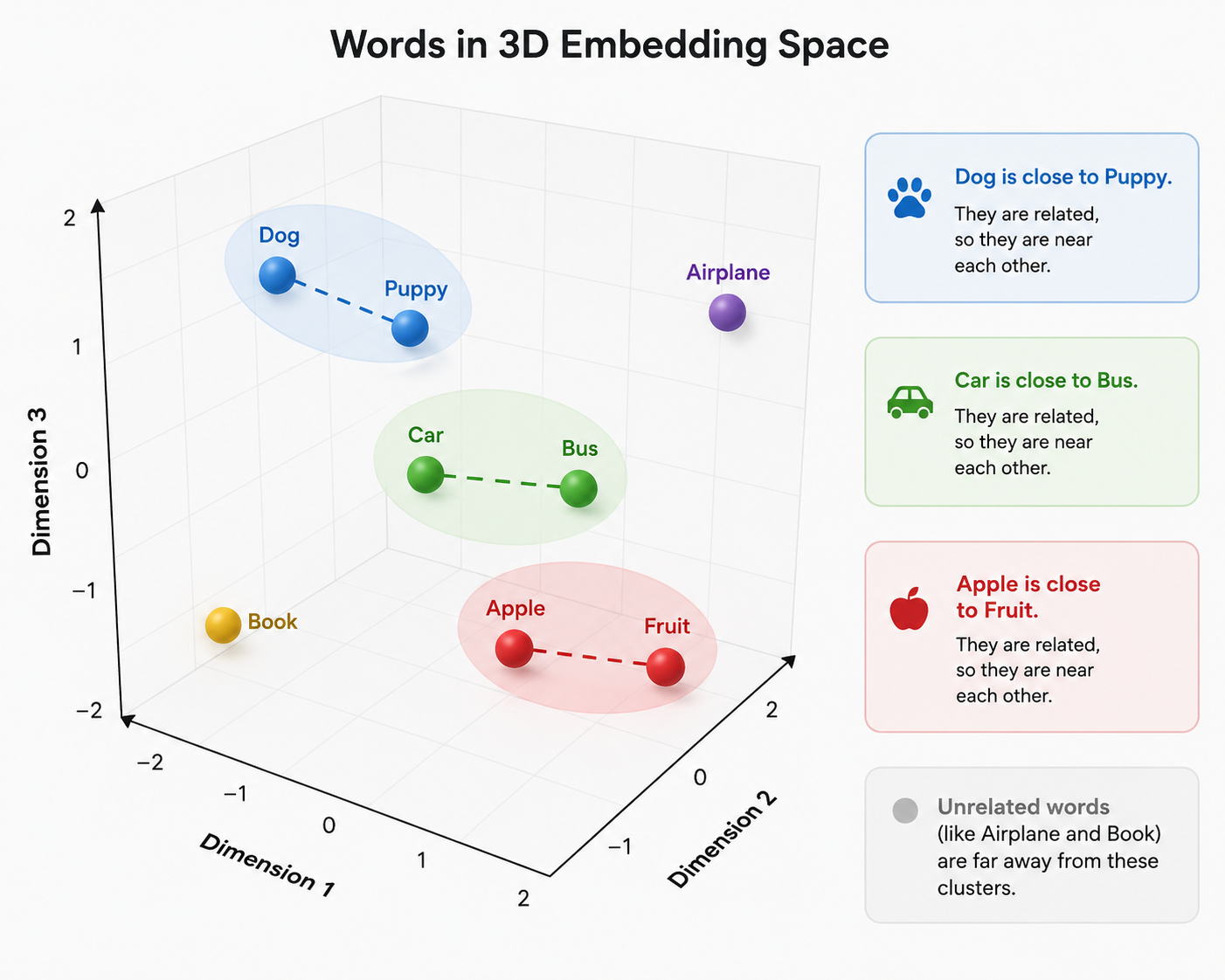
Imagine a huge map.
Words with similar meanings are placed close to each other.
For example:
- Dog is close to Puppy.
- Car is close to Bus.
- Apple is close to Fruit.
But Dog and Airplane will be far apart because they are unrelated.
This is how AI understands relationships between words.
It doesn't memorize definitions.
It learns patterns.
But There's One Problem
Look at these two sentences.
Dog bites man.
Man bites dog.
Both sentences contain exactly the same words.
Yet they mean completely different things.
If AI only looked at the words themselves, it wouldn't know the difference.
That's why we need Positional Encoding.
What Is Positional Encoding?
Positional Encoding simply tells AI where each word appears in the sentence.
For example:
Dog → Position 1
Bites → Position 2
Man → Position 3
Now AI knows not only what the word is, but also where it appears.
Without positional information, word order would be lost.
Now Comes the Most Important Part: Attention
Imagine you're reading this sentence:
"The dog chased the cat because it was scared."
Who is "it"?
The dog?
Or the cat?
This is where Attention comes in.
Attention allows every word to look at every other word in the sentence and decide which ones are important.
Instead of reading one word at a time, AI connects all the words together and understands their relationships.
This idea completely changed modern AI.
What Is a Transformer?
Many people think Attention and Transformer are the same thing.
They are not.
A Transformer is the complete architecture.
Inside it, Attention is one of the most important components.
A simplified flow looks like this:
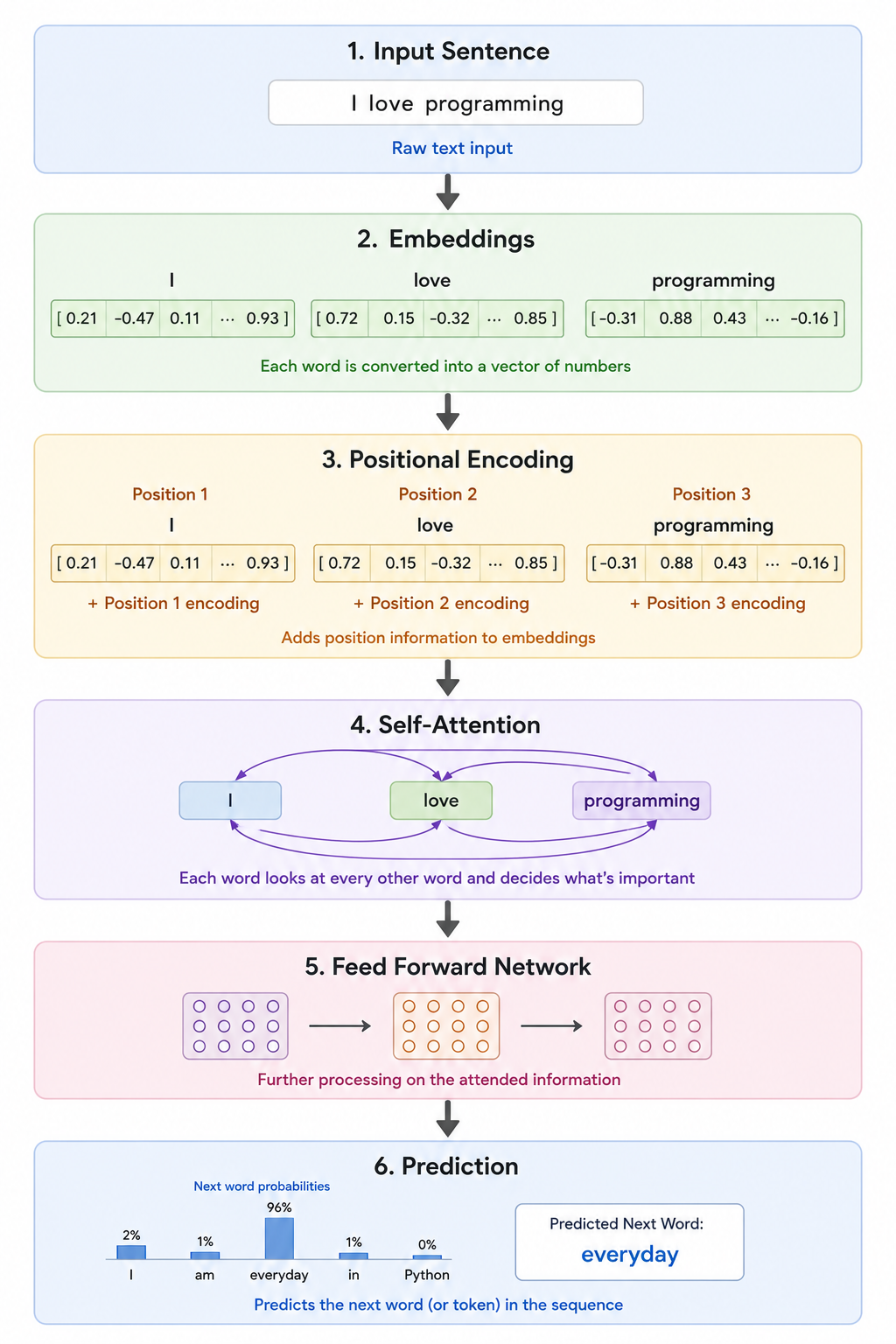
Everything works together to help AI understand language.
How Does AI Answer Questions?
Suppose we ask:
What is the capital of France?
AI doesn't search Google while answering.
Instead, after processing the sentence, it predicts the most likely next word.
Something like this happens internally:
Paris → 98%
London → 1%
Berlin → 1%
Since Paris has the highest probability, AI chooses it.
That's why language models are often called next-token predictors.
But How Does AI Learn?
Imagine a teacher asks:
The capital of France is ______.
If a student answers:
London
The answer is wrong.
The teacher needs to tell the student how wrong the answer is.
This is exactly what Cross Entropy Loss does.
It measures how far the prediction is from the correct answer.
Higher loss means the prediction was poor.
Lower loss means the prediction was good.
Learning From Mistakes
Knowing the mistake isn't enough.
AI also needs to improve itself.
That's where Backpropagation comes in.
Backpropagation looks at the mistake and updates millions or even billions of internal parameters called weights.
These tiny updates help the model perform slightly better next time.
This process happens over and over again during training.
Millions of examples.
Billions of calculations.
Tiny improvements every single time.
The Complete Learning Process
If we combine everything together, AI training looks like this:
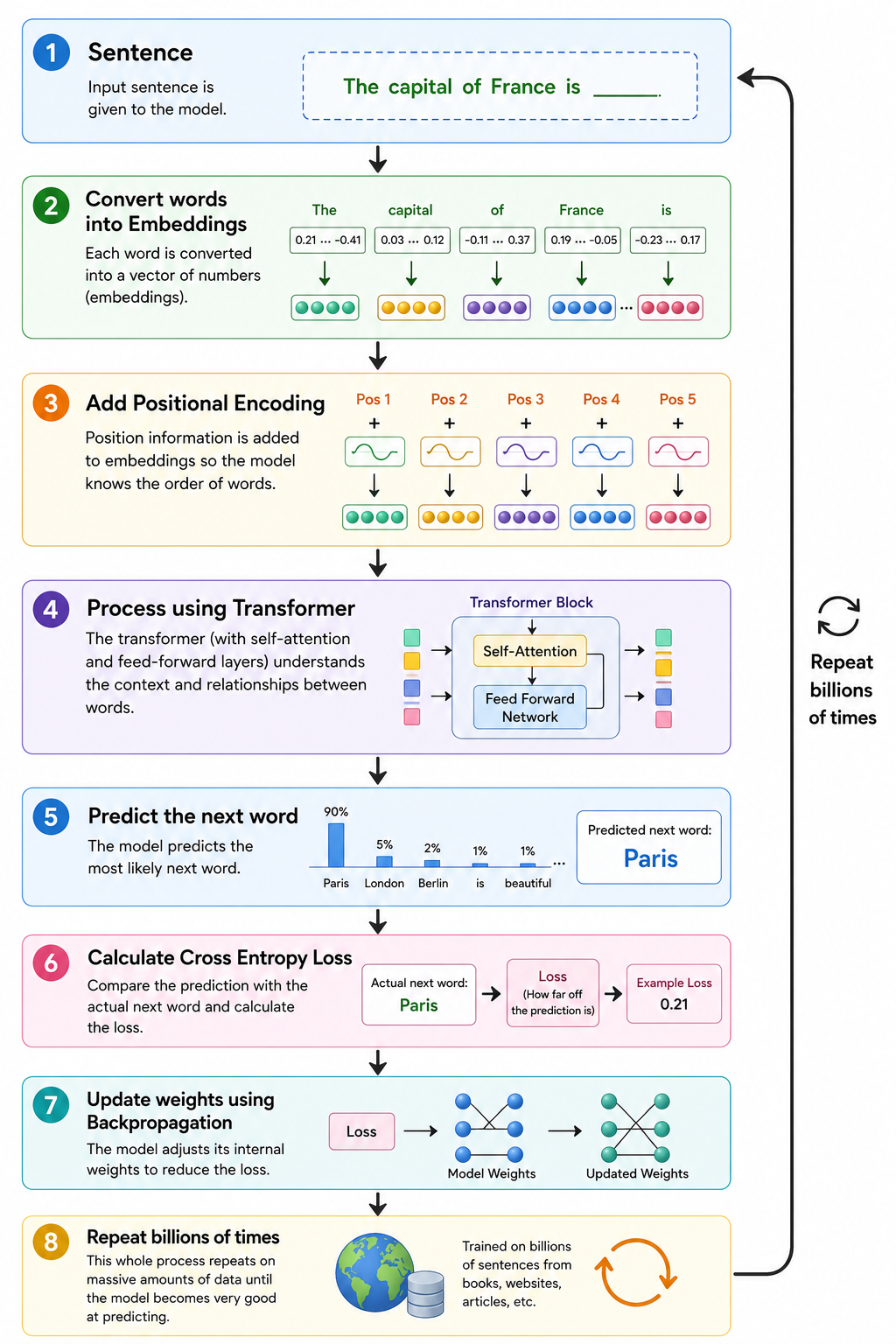
This cycle is repeated until the model becomes very good at predicting language.
What Is BLEU?
When AI translates one language into another, we need a way to measure how good the translation is.
One popular metric is BLEU, which stands for Bilingual Evaluation Understudy.
BLEU compares the AI's translation with a human-written translation.
A higher BLEU score usually means the translation is closer to the reference.
Although modern AI systems now use several evaluation methods in addition to BLEU.
Final Thoughts
When I started learning AI, I thought it was full of impossible mathematics and complicated algorithms.
But after understanding each concept separately, I realized something important.
AI is not one giant concept.
It's a collection of simple ideas that work together.
- Embeddings help AI understand words.
- Positional Encoding helps AI understand word order.
- Attention helps AI focus on important words.
- Transformers combine everything into one powerful architecture.
- Cross Entropy Loss measures mistakes.
- Backpropagation helps AI learn from those mistakes.
Once these building blocks become clear, understanding modern AI becomes much easier.
If you're just starting your AI journey, don't try to learn everything at once.
Learn one concept at a time.
Soon, you'll realize that what once looked incredibly complex is actually a series of simple ideas connected together. That's exactly how I started understanding AI, and it completely changed the way I looked at machine learning and large language models.
← Back to all articles